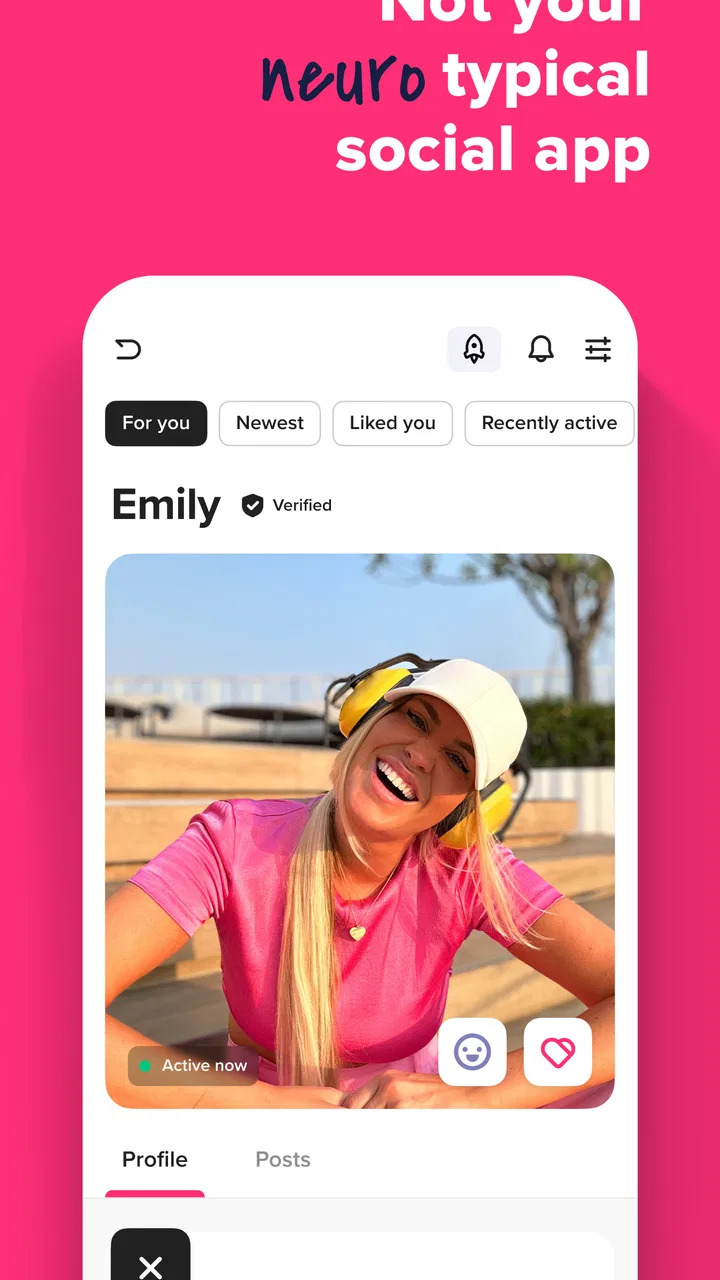
Hiki: Autism ADHD & ND Dating
- 3.5
- Rating
- 100.00K
- Installs
- Free
- Price

 Analysis by App-foxy
I approached Hiki as a social app with a clear purpose: helping autistic, ADHD, and other neurodivergent adults meet people for friendship, dating, or conversation. That focus immediately sets it apart from broad dating services, where users often have to explain their communication style before they can even start getting to know someone. Here, the audience is more specific, and that can make the experience feel more comfortable when you want to be understood rather than treated as an exception.
The app is developed by HIKI, INC. and is free to install, although optional in-app purchases range from $14.99 to $289.99 per item. It carries a Mature 17+ age rating, so it is aimed at adults rather than younger users. The current version is 4.0.22, and it runs on devices using Android 8.0 or later. Those details matter because this is not simply a general-purpose chat room: it is a mature social environment where expectations around dating, boundaries, and personal safety need to be taken seriously.
How Hiki feels during ordinary use
I find Hiki’s everyday appeal less about constant activity and more about having a place where I can approach connection at my own pace. In this section, I’m looking at how that focus can shape the rhythm of browsing and messaging, including the small choices that make social contact feel clearer rather than more demanding.
You May Also Like

 AccuWeather: Weather Radar
AccuWeather Review: A Quick, Clear Forecast for Everyday Decisions
For everyday plans, the best forecast is the one you can understand quickly. AccuWeather makes rain timing, radar, and local conditions easy to act on, with a few trade-offs.

 Hill Climb Racing
Why Hill Climb Racing Still Turns Crashes Into One More Run
A tiny car, a bumpy hill and one more upgrade: Hill Climb Racing keeps resurfacing because its simple chaos makes every near-miss feel personal.

 AliExpress - Shopping App
AliExpress Makes Global Shopping Feel Personal, but Shoppers Bear the Risk
AliExpress turns a global marketplace into a pocket-sized discovery engine. Its reach is useful, its shopping loop compelling, and its trade-offs easy to miss.

 Lords Mobile: Kingdom Wars
Lords Mobile Is a Kingdom-Building Routine, Not a Quick Match
A case-by-case verdict on the building, battles, device demands, and social commitments that make Lords Mobile rewarding for some players and exhausting for others.

 PDF Scanner app - TapScanner
TapScanner Makes Paperwork Easier to Capture, Check, and Share
TapScanner makes scanning with a phone feel less like a rescue operation and more like a dependable step in getting work done. Its capture tools are useful, though not flawless.

 Block Blast!
 Shows How Much a Puzzle Game Can Leave Out
A quiet grid game shows why puzzle players increasingly value instant clarity, repeatable skill and low-pressure play—and where the genre still needs to catch up.
More From Our News Desk
View All News


Speed expectations before you start matching
My first expectation with an app like this would be instant activity, but a niche community works differently from a huge mainstream dating service. Hiki has passed 100K installs, with an average rating of 3.5 from roughly 3.9K ratings, so it has a meaningful user base without feeling like one of the enormous platforms where every swipe produces a new profile. In practical terms, your experience will depend heavily on where you live, what age range you choose, and whether you are looking for friendship, dating, or a more specific kind of connection.
That is not necessarily a weakness. A smaller, more focused audience can reduce the feeling of sorting through people who are clearly looking for something unrelated to you. The trade-off is that discovery may feel slower, especially outside large cities or when your preferences are narrow. I would not install it expecting a continuous stream of new conversations. I would install it expecting a more deliberate search for people who already understand the reason the app exists.
The store summary describes the experience as meeting, dating, and finding neurodivergent friends. That combination is important because not every user wants romance. Someone who has recently moved, struggles with conventional social settings, or wants friends who understand sensory overload may find the friendship angle more useful than the dating side. I like that this broadens the app beyond the usual swipe-and-date routine, but it also means you should be clear with yourself about what you want before engaging with people.
In a normal evening, I would use Hiki in short sessions rather than leave it open continuously. I would review a few profiles, read the wording carefully, and send a message only when I had something specific to say. That approach suits the app better than treating it like a rapid-fire matching machine. It also reduces the pressure to answer several conversations at once, which can be tiring for users who already find social notifications demanding.
What happens when usage becomes heavier
Heavy use is less about demanding graphics and more about the mental load of social interaction. Hiki is a social app, not a visually intensive game, so the difficult part of a busy session is likely to be keeping track of conversations, profile details, and personal boundaries rather than rendering complex content. If you receive several messages, the app becomes more useful when you treat it as a place to choose conversations deliberately instead of an inbox that must be cleared immediately.
A realistic everyday scenario would be checking Hiki after work, responding to one person who asked a thoughtful question, and then browsing profiles for a few minutes before closing the app. On another day, you might use it to look for local friendship rather than a date. The value comes from being able to return when you have the energy, not from staying available all day. I would recommend turning the experience into a routine that fits your attention and sensory needs rather than allowing every alert to dictate your evening.
One useful habit is to write messages that make your expectations clear early. If you prefer direct questions, slower replies, text-only communication, or a friendship-first approach, saying so can prevent misunderstandings. This is a particularly good fit for Hiki because the app’s audience may include people with very different communication rhythms. A message that seems obvious to one person may not be obvious to another, so clarity is more valuable than trying to sound effortlessly casual.
Another practical tip is to separate browsing from conversation. I would spend one short session looking at profiles and another replying to messages, rather than doing both whenever I feel distracted. That makes the app easier to manage and helps prevent the common social-app problem of opening it for a quick look and ending up mentally exhausted. It is not a special button or hidden mode; it is a workflow that makes a focused community easier to use.
Stability and the importance of recovery
The current release, 4.0.22, shows that the app is actively maintained as a product rather than being an abandoned community experiment. In my view, that is reassuring for anyone deciding whether to invest time in building conversations there. Still, no version number can guarantee a perfect experience on every phone, and social apps are particularly dependent on account activity, network conditions, notifications, and the behavior of other users.
For me, reliability in Hiki would mean more than simply opening without crashing. It would mean being able to return to a conversation, understand where I left off, and feel confident that the app is not making the social process more confusing than it needs to be. The most important recovery is also personal: if a conversation becomes uncomfortable, you should feel free to pause, stop replying, or remove yourself rather than treating a match as an obligation.
That point is easy to overlook because dating apps encourage momentum. Hiki’s neurodivergent focus may make direct communication feel more natural, but it does not remove the need for caution. A compatible identity or shared diagnosis does not automatically make someone trustworthy. I would avoid sharing an address, workplace details, financial information, or private images early on. If a conversation moves toward meeting in person, a public location and a clear exit plan are sensible choices.
The app’s Mature 17+ rating also sets the right expectation that conversations may involve adult dating topics. That does not mean every interaction will be romantic or sexual, but it does mean users should be prepared to manage adult boundaries. I would skip Hiki for a child or teenager and would also avoid it if you are looking for a tightly supervised social environment. It is better suited to adults who can make their own decisions about contact and disengagement.
Device limits and everyday practicality
Hiki supports Android 8.0 and later, which makes it accessible to people who are not using a recent flagship phone. That is helpful for anyone keeping an older device, though the age of a phone can still affect how comfortable a social app feels. Screen size, available storage, battery condition, and the way a device handles background activity can all influence whether checking messages feels smooth or irritating.
Because this is not a graphics-heavy game, I would not choose a phone for Hiki based on processor power. A readable screen and dependable connectivity matter more. If you use an older phone, the practical test is simple: can you read profile text without strain, type comfortably, and return to the app without losing your place? If the answer is yes, the minimum operating system requirement should not be a major obstacle.
Resource demands are also likely to be modest compared with video streaming or 3D games, but I would still avoid assuming that every social feature is effortless on every device. Message-heavy sessions can become inconvenient when your keyboard is slow, your connection is unstable, or notifications are overwhelming. If you are sensitive to interruptions, checking the app manually may be better than allowing it to compete with work, sleep, or other conversations.
Recovery after a break is another part of device practicality. I prefer social apps that I can close without feeling that I have missed a critical moment, and Hiki is best approached with that attitude. You do not need to answer immediately simply because a message arrived. Returning later with a clear reply is healthier than forcing yourself to participate when you are overloaded. That is especially relevant for users managing attention differences, fatigue, or anxiety around social expectations.
Where it beats the usual alternatives
The strongest reason to choose Hiki over a mainstream dating app is its starting point. On a general service, you may need to filter out people who do not understand neurodivergence, disclose personal information before you feel ready, or tolerate communication habits that make you uncomfortable. Hiki gives you a better chance of meeting people who already recognize that brains, routines, and social preferences vary.
That does not make it automatically better for everyone. A large dating platform may be preferable if your priority is the widest possible local pool, a very specific dating format, or a mature set of discovery tools you already know well. A general social network may be better if you want to connect around hobbies without dating being part of the environment. Hiki’s advantage is not maximum scale; it is relevance.
I also see a meaningful difference between Hiki and a conventional friendship forum. Forums can be excellent for shared interests, but they may not provide the same direct path toward one-to-one dating or friendship. Hiki brings those possibilities together, which is useful if you are open to different kinds of connection. The downside is that mixed intentions can create ambiguity, so profile reading and honest messaging matter more than they would in a single-purpose community.
Its average rating of 3.5 and around 1.1K written reviews suggest a mixed but substantial response from users. I would read that as a reason to keep expectations realistic, not as a reason to dismiss the app. A focused community can be genuinely valuable to one person and feel too quiet or limited to another. The right question is whether the audience matches your needs, not whether the rating alone settles the decision.
Who will get the most from it
I think Hiki is a strong candidate for adults who want to meet autistic, ADHD, or otherwise neurodivergent people without having to frame their identity as a problem to be explained. It may also suit someone returning to dating after a difficult experience with mainstream apps, especially if directness and shared understanding are more important than a large number of matches.
It can be useful for a person who wants to practice social connection at a manageable pace. You might start with profile browsing, move to a short text conversation, and decide later whether you want a date, friendship, or no further contact. That gradual path is more realistic than assuming every match must quickly become an in-person relationship.
I would be more cautious if you want instant results, dislike reading profiles, or feel uncomfortable setting boundaries in online conversations. The app cannot solve loneliness by itself, and a niche audience does not guarantee that every interaction will be kind or compatible. Someone who needs a very large local dating pool may have better luck using Hiki alongside, rather than instead of, a broader service.
I would also skip it if you are seeking a fully anonymous space with no adult dating context. The Mature 17+ rating makes the intended environment clear. Likewise, if you are not interested in either friendship or dating with neurodivergent people, the app’s central purpose will probably feel too narrow rather than refreshingly focused.
Free access, purchases, and the decision to continue
The free entry point makes it reasonable to try Hiki without committing money immediately. That matters for a community-based app because you need to see whether there are people you genuinely want to meet in your area and whether the communication style suits you. I would spend time learning how active the community feels for my own preferences before considering any optional purchase.
The listed in-app purchase range, from $14.99 to $289.99 per item, is wide enough that I would approach paid options carefully. I would not buy anything simply to make the app feel more productive. First I would ask whether the free experience already gives me enough opportunity to browse, communicate, and decide if the community is right. If the answer is no, paying more may not fix a local shortage of compatible users.
A sensible workflow is to use the free version during a normal week, note whether you are finding meaningful profiles, and judge the quality of conversations rather than the number of notifications. That prevents the usual mistake of measuring a dating app by activity alone. Ten shallow exchanges are not necessarily better than one respectful conversation that fits your pace.
My performance verdict
Hiki feels most successful when I treat it as a focused social space rather than a high-speed matching machine. Its performance story is therefore tied to two things: whether your device meets the Android 8.0 requirement and whether the community around your preferences is active enough to support real conversations. The app’s relatively accessible system requirement is a positive for older Android users, while the niche audience naturally makes location and timing important.
I would recommend it to an adult who wants a more relevant starting point for neurodivergent friendship or dating and is comfortable moving slowly. I would not recommend relying on it as the only way to meet people, especially if you live somewhere with limited activity or need immediate matches. Used patiently, it can reduce the exhausting work of explaining yourself from the beginning. Used with unrealistic expectations, it may feel quiet, repetitive, or emotionally demanding.
My final advice is to judge Hiki by the quality of the connections it helps you begin, not by how quickly it fills your screen. Keep your profile honest, state your communication preferences, protect personal information, and give yourself permission to leave conversations that do not feel right. For the right adult user, that combination of targeted community and flexible pacing makes Hiki worth trying as a free social app, even though it is not a universal replacement for larger dating or friendship platforms.
FAQs for Hiki: Autism ADHD & ND Dating
01What is Hiki: Autism ADHD & ND Dating?
Hiki is a dating and social networking app created for autistic, ADHD, and other neurodivergent adults. It is designed to make meeting people more comfortable by connecting users who may share similar experiences, communication preferences, and interests. Depending on your goals, you can use it to look for friendship, conversation, community, or romantic relationships in a more understanding environment.
02Who can use Hiki, and is it suitable for neurotypical users?
Hiki primarily focuses on neurodivergent people, including autistic individuals, people with ADHD, and members of the broader neurodiverse community. The app’s purpose is to provide a space where users can feel understood rather than judged for communicating differently. Eligibility and community guidelines may change, so prospective users should review the current requirements, age restrictions, and terms before creating an account.
03Is Hiki free to download and use?
Hiki can generally be downloaded at no initial cost, allowing users to create a profile and explore the service. However, some features may be limited by a subscription, premium plan, or in-app purchase, depending on the current version and platform. Before subscribing, check the app’s store listing and payment screen carefully for pricing, renewal terms, trial conditions, and cancellation instructions.
04How does matching and messaging work on Hiki?
After setting up a profile, users can typically present their interests, identity, communication style, and relationship preferences to help others understand them more easily. Matching or discovery tools then allow people to find potentially compatible members, while messaging features support conversations after the relevant interaction or connection is made. The exact experience can vary by location, account type, and app updates.
05Is Hiki safe for meeting people online?
Hiki includes a community-focused environment, but no dating or social app can remove every online safety risk. Avoid sharing your home address, financial information, passwords, or intimate content with strangers, and be cautious of anyone requesting money or pressuring you. Use blocking and reporting tools when necessary, verify a person gradually, and arrange any first in-person meeting in a public place.
Pros
- Designed specifically for autistic
- ADHD
- and neurodivergent singles.
- Profile prompts encourage users to share communication preferences openly.
- Community-focused features can make dating feel more inclusive.
- Useful for finding people who understand sensory and social differences.
- Supports connections based on shared identity and lived experience.
Cons
- The user pool may be smaller than on mainstream dating apps.
- Some features may require a paid subscription or in-app purchases.
- Location coverage can vary significantly between cities and countries.
- Dating outcomes depend heavily on how active the local community is.
- Users should still watch for fake profiles and online dating scams.

Hiki: Autism ADHD & ND Dating
Gallery